Kellogg's - Packaging Design Project
Discussing my portfolio with a professional graphic designer at P&G, I was informed that it was lacking skills in packaging illustration design. This was great feedback, and I decided to start a project addressing just that.
Beyond illustration, a crucial skill in packaging design is the ability to adhere to an existing brand’s visual identity. For this reason, I chose Kellogg’s; with their bright red logo and bold block colours, Kellogg’s is a brand that’s instantly recognizable, making it an ideal subject for refining my ability to work within established brand guidelines. Additionally, the brand’s wide variety of cereal offerings presents the perfect opportunity to extend their product line while staying true to their visual identity.
Skills Gained:
- Packaging Design.
- Packaging Illustration.
- Understanding of branding identity.
- Use of Adobe Illustrator.
- Use of Adobe Photoshop.
Research
I began by exploring all of Kellogg’s sub-cereal brands to identify a single one I would work with. I concluded with their ‘Crunchy Nut’ cereals, as their visual identity is extremely specific, and they have few flavour variations, it presents as the perfect challenge to be creative within constrict boundaries. As there is no public brand identity guideline for Kellogg’s Crunchy Nut, I conducted my own short analysis.


Process
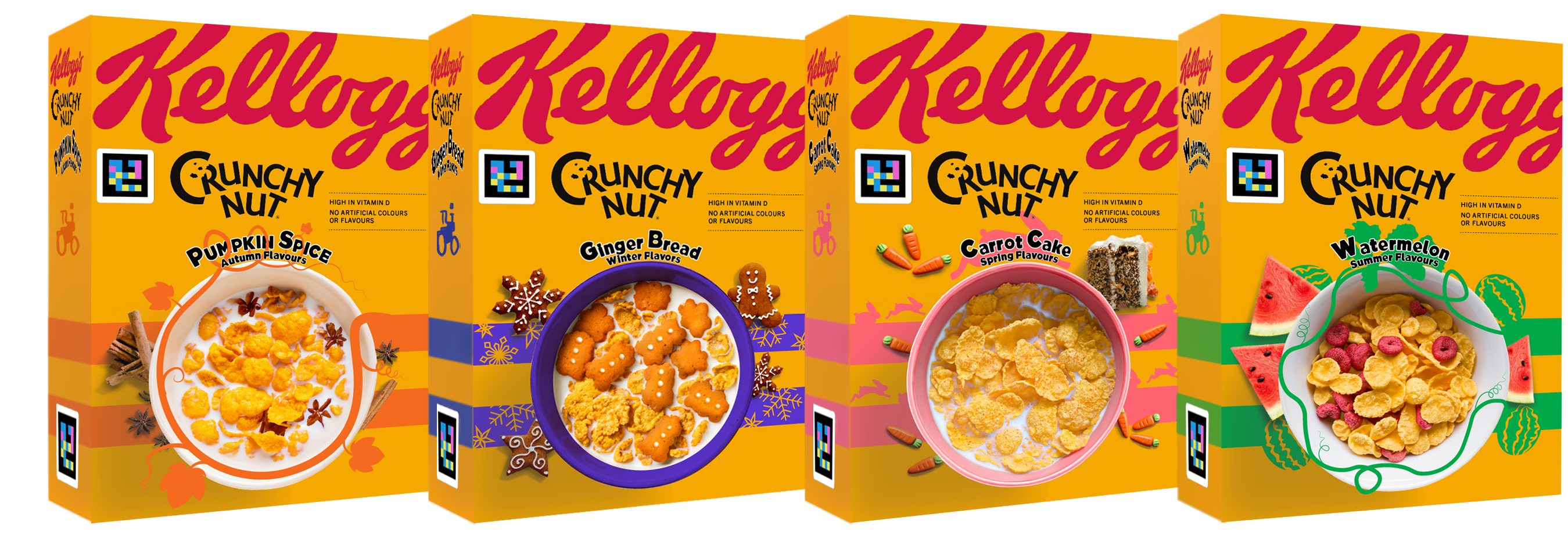
For my four new Crunchy Nut flavours, I chose a four seasons theme to create a cohesive line, with each flavour inspired by popular sweet ingredients associated with each season. This concept results in four limited-edition flavours, each available for four months, keeping a fresh lineup throughout the year. The chosen ingredients themselves aren’t the centre point of this project, but rather how I compose the package in order to make them appealing.
As each flavour would follow the same strict guidelines, I began by creating vector images of the Kellogg’s logo, orange background and subtexts.
Autumn
For autumn, pumpkin spice is the obvious choice. Following my brand guidelines, I would need to photograph images and graphics related to the ingredient. I began by creating the cereal bowl. As I do not have access to a photographer, I used photoshop generative AI to create a pumpkin spice corn flakes image. For the surrounding ingredients, I used photoshop to edit an existing photograph of raw pumpkin spice.


Exporting the result into Illustrator, once again following the guidelines, I had the option of creating simple graphics. Using pumpkin vines not only emphasises the flavour, but also creates a visual flow, guiding the viewer through the visual hierarchy after the bright red logo: around the bowl and ending on the flavour name.
Exporting the image back into photoshop I added the final touches, such as shadows and brightness adjustments, the result is a visually appealing, clearly autumn themed flavour with fairly realistic imagery and flowing graphics.


Winter
For winter, I picked gingerbread. For the photography, I once again sourced my ingredients imagery from an image. However, this time photoshop’s generative AI couldn’t quite capture my vision for the cereal bowl, so I edited the gingerbreads in myself through blend modes and brush strokes.


For the graphics, I decided to take a different approach. As the gingerbread is already quite bold, I decided to add more small detail surrounding the bowl with vectors of snowflakes.
The final package gives an obvious winter tone through dark blue colours and seasonal imagery.


Spring
For spring, I picked Carrot Cake. For the slice of cake and carrot shavings, I extracted it from an existing image. However, I could not find an adequate image for candy carrots that contained correct lighting. Therefore, I decided to generate them through an AI.


For the graphics, I decided to experiment with adding more imagery instead (as a lack of graphics is a possibility according to the guidelines). However, I felt it lacked visual interest and cohesiveness with the rest of the line.
As the slice of cake takes a lot of space, I decided to create smaller graphics to balance the package. Additionally, to create a cohesive line, I decided to mimic winter’s use of graphics along the background stripes.
Perhaps a strange flavour choice, the final result creates an appetising rendition of carrot cake flavoured cereal through its imagery and easter bunny-like graphics.


Summer
For summer, I picked watermelon flavour. For the photography, I decided to use generative AI to create my cereal bowl and watermelon slices, as it assures correct lighting, easy to extract background and overall faster process.


As the watermelon slices are quite large, only few can be used which, without graphics, results in visuals feeling bare, even with smaller watermelon graphics. Instead, I decided to use vines to fix this as well connect it to the autumn flavour. However, to visually distinguish the two flavours, I used curvy lines that contain the same flow but also communicate the characteristic thicker, heavier watermelon vines.


Conclusion

I created a final edit demonstrating all the flavours together. I find the final outcome follows the constrictive brand identity guides of Kellogg’s Crunchy Nut while still being creative through graphics and imagery. The visual outcome is pleasant, despite not having access to a photographer. If I were to expand this project, I would create a “100 anniversary” Kellogg’s Corn Flakes line, using their “Kellogg’s Vintage” sub-brand, to more fully explore my creativity while still adhering to a brand guideline.